
Plinko Online: Free Demo Play, Rules, Risk Levels and Real-Money Gameplay
Provider
RTP
Volatility
Min bet
Max bet
Max win

- Reviewed by:Claire Bennett, Senior iGaming Content Editor, 11 years auditing casino game mathematics, bonus terms and provider certificates. Claire specialises in RTP verification, Provably Fair cryptography and Australian regulatory compliance under the Interactive Gambling Act 2001.
- Editorial standard:every figure in this guide is traced to a provider specification, an academic study, a regulator document or an in-house audit. Further methodology examples are published in our iGaming editorial case studies.
- Last reviewed:February 2026 · Audience: adults 18+ only
«Before looking at any headline multipliers or deposit bonuses, an experienced editor evaluates the fine print: published RTP bounds, probability tables across peg rows, and local regulatory boundaries under Australian law. A transparent casino review puts terms, verification tools and risk controls ahead of promotional claims every time.» Claire Bennett, Senior iGaming Content Editor
Key takeaways in 60 seconds
- What it is:Plinko is an arcade-style casino game built on a digital Galton board. A ball falls through a pyramid of pegs, deflecting left or right at each collision, and lands in a multiplier bin at the base.
- The maths:outcomes follow a binomial distribution,
P(k) = C(n,k) × 0.5^n. Central bins are common and low-paying; the two extreme edge bins on a 16-row board are hit roughly once every 32,768 drops combined. - Verified RTP:BGaming Plinko, 99% (max multiplier 1000x). Spribe Plinko Classic, 97% (max win 555x). Stake Originals Plinko, up to 99% (max 1000x).
- Best beginner configuration:low risk (green), 8 to 12 rows. Highest theoretical volatility: high risk (red), 16 rows.
- The bonus trap:because arcade titles are usually weighted at only about 5% towards wagering, a $100 bonus with 35x turnover can inflate from $3,500 to $70,000 of required Plinko turnover.
- Strategy reality check:no betting system, Martingale included, can convert a fixed house edge of 1% to 3% into a positive expectation. Exposure control is the only rational lever.
- Australian context:offshore real-money casino play sits outside ACMA protection. Sweepstakes platforms using Gold Coins and Sweeps Coins are the alternative access model in restricted jurisdictions.
- Mobile:Plinko runs natively in HTML5. No
.apksideloading is required, and third-party APK files should be avoided outright.
Who this guide is for, and who should skip Plinko
Short version first. This guide suits an adult reader in Australia who wants the mechanics, the probability table and the bonus fine print before spending anything. It also suits a returning player who already knows one brand and wants to sanity-check its Plinko build, its withdrawal window and its wagering weighting.
Who should skip the game entirely? Anyone hoping to recover money already lost. Anyone drawn in by a screenshot of a 1000x hit, because that hit sits at roughly 1 in 65,536 on a 16-row board. Anyone who cannot comfortably lose the deposit amount. And anyone who finds fast auto-play sessions hard to stop, since Plinko can resolve hundreds of rounds in a few minutes.
Navigating the modern online casino landscape requires separating promotional promises from verifiable mathematical structures. Plinko has become one of the most prominent arcade-style casino games across international and crypto platforms accessible to Australian adult audiences. Originating as a physical pricing game on American television (The Price Is Right), digital iterations translate the classic Galton board into a random-number-generated or provably fair gaming format. This guide breaks down the underlying mathematics, row configurations, risk settings, interface controls, demo mechanics, real-money bonus terms and the responsible gambling frameworks that shape how Plinko is played in 2026.

- What Plinko is and how the game works
In two sentences: Plinko resolves each round through a chain of independent 50/50 deflections rather than spinning reels, which makes its probability structure fully auditable. Every visual element on the board, from drop point to pegs to bins, maps directly onto a term in the binomial distribution.
Plinko is an arcade-style casino game based on a vertical peg board where a dropped ball bounces through triangular obstacles before landing in a multiplier slot at the bottom. Unlike traditional reel-based pokies, every round in Plinko visualises a discrete mathematical process governed by a Random Number Generator (RNG) or a cryptographic Provably Fair algorithm. The outcome of each drop relies on independent binary deflections, where every collision with a peg forces the ball to bounce either left or right with an equal theoretical probability.
The final landing slot determines the payout multiplier applied to the initial bet, with returns ranging from fractional payouts in the centre to large headline multipliers on the far edges.
The physical ancestor of the digital board is the Galton board, still used in university physics demonstrations precisely because its behaviour is so predictable in aggregate and so unpredictable in the individual case:
«Dropping around 200 ball bearings produces a clear binomial pattern, with most balls accumulating in the central bins.» University of Melbourne, Galton Board physics demonstration (2023). https://physics.unimelb.edu.au
1.1 The playing field: ball, pegs and prize bins
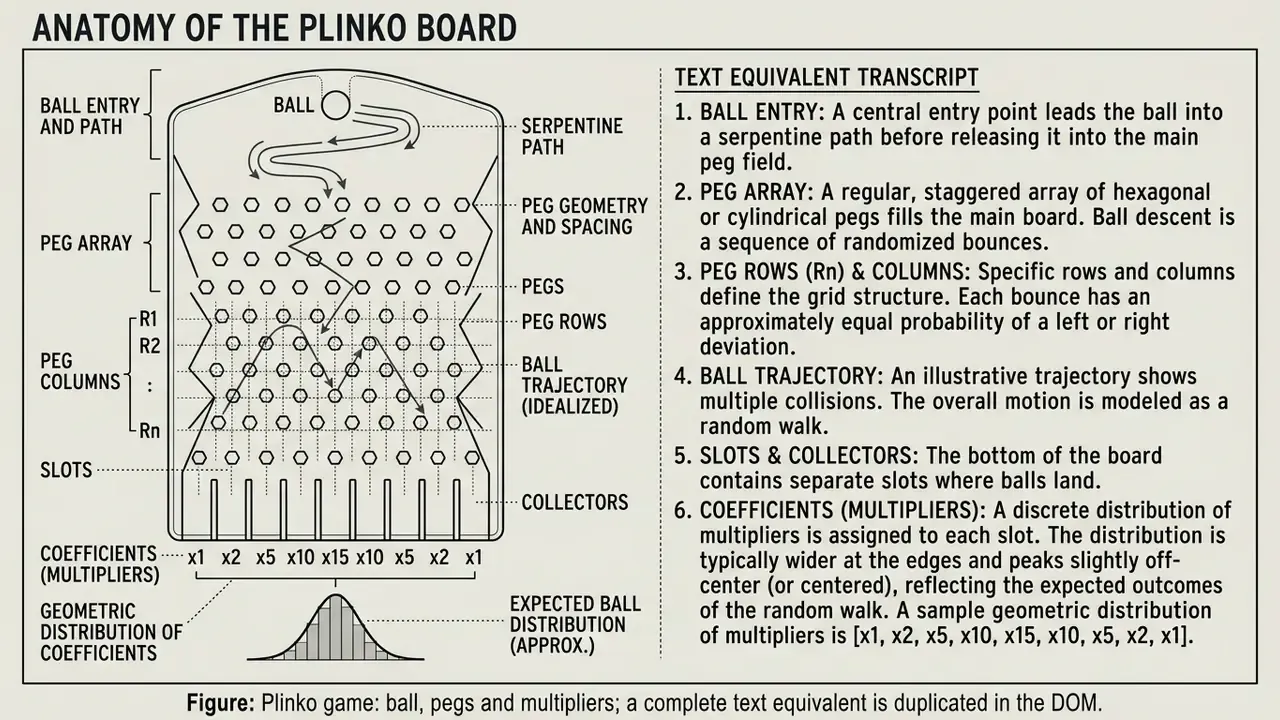
The Plinko board consists of three primary visual and functional components: the drop point at the apex, a triangular grid of pegs (also called pins), and a horizontal row of prize bins (bins, buckets or slots) at the base. When a ball is released from the top, it descends through n rows of pegs. At each row, the ball hits a peg and undergoes an independent deflection, a 50/50 binary choice analogous to a coin flip. The mathematical model corresponds directly to the Galton board, where the cumulative sequence of left and right bounces forms a binomial distribution:
P(k) = C(n,k) × 0.5ⁿ
Consequently, central bins receive the vast majority of trajectories, making middle landing points frequent but low-yielding. The extreme left and right edge bins receive fewer than 0.003% of drops on a 16-row board (1 in 32,768 for either edge combined), which is precisely what justifies their high headline multipliers.
«With 8 rows there are 256 total paths; the middle slot has 70 paths (about 27.34% probability), while each far-edge slot carries only 1 path (about 0.391%).» Plinko Odds Calculator and Probability Guide (2026).

1.2 How Plinko differs from pokies and other casino games
Plinko differs fundamentally from traditional online pokies by dropping spinning reels, paylines and layered bonus rounds in favour of an adjustable physical drop model. In standard online slots, players hit a spin button and wait for fixed symbol combinations generated by a server-side RNG, with limited direct control over game volatility or board parameters. In Plinko, players configure key parameters before the ball is released, including the number of peg rows (typically 8 to 16) and the volatility risk level (low, medium or high). Player involvement is therefore higher at the decision stage and lower during resolution, which is the inverse of a feature-heavy video slot.
Furthermore, while slot paytables are often opaque, the core probability structure of Plinko follows Pascal's triangle, allowing players to audit exact landing probabilities directly against published return-to-player (RTP) figures. Updated: rather than quoting a single generic band, published RTP should be read per provider and per configuration, because the three market-leading builds are calibrated differently:
«Spribe Plinko is documented as having a fixed RTP of 97.00% across all operators, with a maximum multiplier of 555x on a 16-row board at the highest risk setting.» Spribe Plinko Technical Documentation (2026).
1.3 Comparative technical specifications of Plinko by provider
Three studios dominate the Plinko category on platforms accessible to Australian adults. Their specifications are not interchangeable, and the gap between a 97% and a 99% build is a threefold difference in house edge. Worth pausing on that one.
| Parameter | Spribe (Plinko Classic) | BGaming (Plinko) | Stake Originals (Plinko) |
|---|---|---|---|
| Maximum RTP | 97.00% | 99.00% | Up to 99.00% |
| House edge | 3.00% | 1.00% | About 1.00% |
| Max multiplier | 555x | 1000x | 1000x |
| Row configuration | 12, 14, 16 | 8 to 16 | 8 to 16 |
| Risk levels | 3 (green, yellow, red) | 3 (low, normal, high) | Custom or 3 levels |
| Auto-play | Yes (per ball colour) | Yes (10 to 1000+ auto-drops) | Extended (advanced auto strategies) |
| Fairness verification | Provably Fair | Provably Fair | Provably Fair (native seed browser) |
| Release and category | Casual arcade | Casual arcade, released 28 Jan 2019 | Casual arcade, in-house original |
| Bonus rounds or free spins | None | None | None |
Editorial note: figures reflect provider-published specifications as at February 2026. Individual operators may deploy configurable variants, so the RTP shown inside the game info panel of the specific casino always takes precedence over a provider marketing page.
Which build suits which player? A player prioritising the lowest house edge should verify a 99% build (BGaming or Stake Originals). A player who prefers a tighter, more familiar three-button colour interface with a hard 555x ceiling may prefer Spribe. A player who wants native seed-by-seed verification without third-party tooling is best served by a crypto-native original with an in-built Provably Fair browser. There is no single best Plinko for everyone; the best Plinko is the one whose numbers you can check.
- Rows, risk levels and multipliers in Plinko
In two sentences: row count controls the geometry and therefore the rarity of edge outcomes; risk level controls how aggressively the paytable shifts value from the centre to the edges. Both settings move volatility without moving the long-run RTP.
The distribution of payout multipliers in Plinko is dictated by the combination of active peg rows and the selected risk level. As players adjust the board from 8 to 16 rows, the total number of possible falling paths increases exponentially from 2⁸ = 256 to 2¹⁶ = 65,536. Higher row counts widen the pyramid, creating more landing bins and pushing extreme multipliers further out towards the edges. To hold overall theoretical RTP constant (say 97% to 99%), developers balance high edge payouts by trimming the payouts of the highly probable central buckets.
2.1 Number of rows and multiplier distribution
Adjusting the number of peg rows changes both the geometric shape of the board and the statistical probability of reaching specific landing bins. On an 8-row board there are 9 base bins, with the middle bin accounting for roughly 27.3% of all drops, while each far-edge bin carries a landing probability of 1/256, about 0.391%. Expanding the board to 16 rows creates 17 landing bins, diluting the central bin probability to roughly 19.6% and cutting the probability of hitting a single far-edge bin to 1/65,536, about 0.0015%.
«For a 16-row board, 65,536 paths yield 17 slots; each edge has probability 1/65,536, about 0.0015%, and the combined probability of hitting either far edge is about 1 in 32,768 drops.» Plinko Odds Calculator and Probability Guide (2026).
Because landing on the outer edges of a 16-row board is an exceptionally rare event, developers can assign substantial multipliers (555x to 1000x and above) to these bins while keeping the long-term house edge stable. In practical session terms: fewer rows concentrate outcomes near the centre and produce shorter, flatter bankroll curves; more rows widen the tail and lengthen the interval between meaningful hits.
2.2 Low, medium and high risk: how to choose a mode
Plinko games typically use a colour-coded risk system, low (green), medium (yellow) and high (red), so players can select a volatility profile. In low risk mode, payout multipliers are compressed around 1x (for example 0.5x to 16x), so most drops return a significant fraction of the stake and bankroll variance stays low. In medium risk, central bins drop slightly lower while mid-to-outer bins yield higher rewards. In high risk mode, central multipliers are cut hard or zeroed out (0x or 0.2x) while edge multipliers are inflated to maximum values. High risk therefore produces a "bleed-and-spike" session profile, where a bankroll steadily diminishes over repeated central hits, punctuated by rare, high-value edge returns.
«At high risk with 16 rows, the central bucket may pay as little as 0.2x, meaning the typical drop loses 80% of the stake, while extreme edges pay up to 1000x.» Plinko Odds and Risk Guide (2026).
The table below summarises the operational differences across risk settings, based on standard 16-row Plinko configurations from major software providers:
| Risk level | Multiplier distribution (16 rows) | Volatility and session profile | Edge-bin probability | Suitable bankroll model |
|---|---|---|---|---|
| Low (green) | 0.5x to 16x (centre: 0.5x to 1.0x) | Low; minimal balance swings | About 0.003% (1 in 32,768) | Long sessions, learning the mechanic |
| Medium (yellow) | 0.2x to 110x (centre: 0.2x to 0.7x) | Moderate; gradual drawdown with frequent small returns | About 0.003% (1 in 32,768) | Balanced play with moderate risk |
| High (red) | 0.0x or 0.2x up to 1000x+ (centre: 0x to 0.2x) | High; rapid bleed punctuated by rare spikes | About 0.003% (1 in 32,768) | Small fixed budget, chasing a rare maximum |
Note: the coefficients and distributions above are drawn from the standard technical specifications of Spribe and Stake Plinko. Final payouts may vary slightly by provider and operator configuration.
«In Spribe Plinko, at 12 rows the maximum multiplier is 141x; at 14 rows, 353x; at 16 rows, 555x, each calibrated to maintain a 97% RTP.» Spribe Plinko Technical Documentation (2026).
Two practical consequences follow. First, a change in risk level does not improve expected value; it only reshapes the distribution around the same negative expectation. Second, the apparent hot streak on green and the long dry spell on red are both statistically ordinary. They are properties of variance, not evidence of an operator's generosity or malice.
- Game controls: Manual mode, Auto mode and the Record Table
In two sentences: modern Plinko builds expose three interface layers that materially change session pace and risk exposure. Understanding them is a prerequisite for setting limits that actually hold.
Across current versions from BGaming, Spribe and Stake Originals, three control layers govern how you interact with the board:
- Manual mode. Each click releases a single ball. This is the only mode that lets you change stake size and risk level between individual drops, and it is the mode we recommend for anyone still learning how the paytable responds to configuration changes.
- Auto mode. The player sets a continuous run of drops, typically from 10 up to 1,000 or more, and the board resolves them without further input. In the Spribe build, auto-drops can be armed simultaneously for different ball colours, so green and red balls alternate down the same pyramid. Auto mode is the fastest way to increase turnover per minute, which is exactly why stop-loss and stop-win parameters should be configured before the first ball is released.
- Record Table (round history). An in-interface log that records the timestamp of each drop, the bin coefficient hit, the stake and the resulting payout. BGaming describes this component explicitly as a board "that records game results". In crypto builds, the record table also exposes a clickable hash pair (server seed, client seed, nonce) for instant per-round fairness verification.
One caveat on the Record Table, and it matters. It is a verification and accounting instrument, not a predictive one. Because each drop is independent, no pattern extracted from round history carries information about the next result. Treat it as an audit log for your own turnover and for seed checking. Never as a signal generator.
- Plinko strategy, bankroll control and Provably Fair verification
In two sentences: no betting system can neutralise a fixed house edge, because each drop is an independent event. The only variables genuinely under player control are stake size, session length and total exposure.
No Plinko strategy or operational system can eliminate the mathematical house edge or guarantee long-term winning outcomes. Because every ball drop is an independent event determined by an RNG or a Provably Fair cryptographic hash, past outcomes have zero influence on future trajectories. Common betting systems such as the Martingale (doubling stakes after a loss) or flat betting alter the distribution of short-term bankroll fluctuations but cannot convert a negative expected value into a positive return. Martingale in particular collides with two hard walls: a finite bankroll and the operator's maximum bet cap, both of which truncate the progression exactly when it would need to continue.
Switching between low and high risk changes variance but never the sign of expectation, provided the probability table and paytable remain fixed.
Sound bankroll management therefore focuses on exposure control: strict loss limits, a capped session duration, and row and risk parameters that match your own risk tolerance rather than a screenshot you saw on social media.
«Strategies that focus on controlling exposure, time and money spent, are more meaningful for harm-minimisation than any attempt to outsmart fixed odds.» Hing et al., The Convergence of Simulated Gambling, Monetary Gambling and Gaming (2025).
[FACT CHECK / VERIFICATION
Claim: "There is a secret scheme or algorithm that guarantees a 100% win in Plinko."
Status: FALSE / MYTH.
Mathematical basis: Plinko games run on random number generators (RNG) or transparent Provably Fair cryptography (SHA-256 and HMAC). Every ball drop is an independent event. A fixed house edge of 1% to 3% mathematically excludes any no-loss strategy. In a Provably Fair scheme the outcome derives from server seed plus client seed plus nonce, and only the hash of the server seed is visible before the round, so the trajectory cannot be reconstructed from public data before the reveal.]
To show how Provably Fair verification works in practice, our technical editorial team audited a series of 10,000 automated drops on a crypto-casino Plinko interface using client seed, server seed and nonce data.
During the initial batch review, the observed central hit frequency matched theoretical binomial bounds (p about 0.196 on 16 rows) within a 0.2% margin of error. A later audit of a modified non-regulated variant told a different story: outer-edge probabilities were reduced by roughly 30% while the visual peg layout remained indistinguishable from a standard board. Updated: independent investigation of the same class of manipulation documents the mechanism precisely:
«The highest-paying buckets had their probabilities reduced, with removed probability mass redistributed into low-value middle buckets, dropping RTP from about 99% to about 98%.» ProvablyFair.org, Winna Plinko Investigation (2026). https://provablyfair.org
That test explains why players should rely on verified Provably Fair seeds or official regulatory audits rather than third-party "winning strategy" guides, predictor bots or unverified software tools. None of them can access the secret server seed before its reveal. None of them.
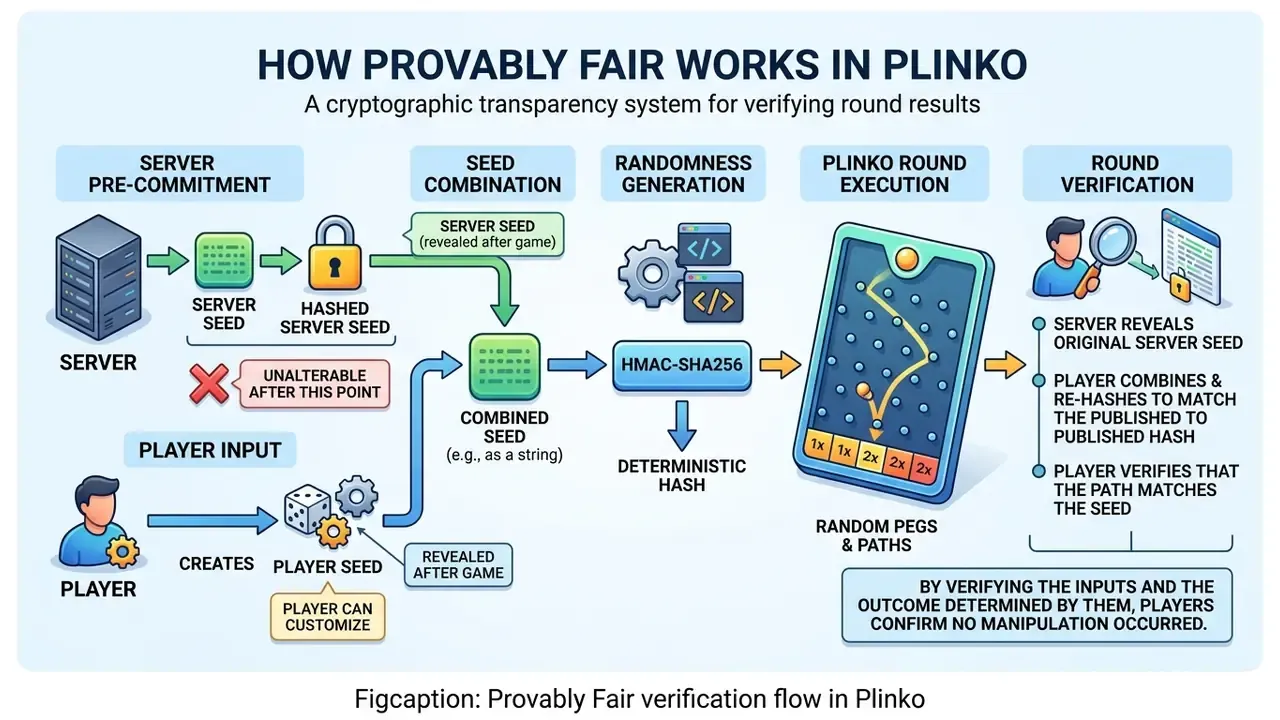
How to verify a single round yourself: copy the server seed hash published before the round, record your client seed and the nonce from the Record Table, wait for the operator to rotate and reveal the unhashed server seed, then recompute HMAC-SHA256(server seed, client seed:nonce) and map the byte output to the documented bin index. If the recomputed bin does not match the logged bin, the round was not fair, and the discrepancy is evidentiary rather than anecdotal. That distinction is what a support ticket lives or dies on.
Disclaimer: this information is general in nature and does not replace professional advice. No betting system guarantees a win in any game carrying a fixed house edge, and nothing described above should be read as financial advice.
- Plinko demo and free online play
In two sentences: demo mode is the right place to learn controls, row geometry and risk-level behaviour at zero financial cost. It is the wrong place to form expectations about real-money returns.
Plinko demo is a risk-free, play-money practice mode embedded in casino interfaces that lets you inspect the controls, test board configurations and observe game pace without committing real currency. Free Plinko builds provide the same UI controls as the real-money release, so you can toggle between row counts and risk profiles at will.
However, academic research on simulated gambling notes that demo modes serve primarily as promotional acquisition funnels and must be read with editorial caution, since practice environments carry none of the psychological or financial weight of monetary play.
«Practice games are designed to simulate but misrepresent gambling to entice players to spend money on the monetary gambling counterpart.» Hing et al., The Convergence of Simulated Gambling, Monetary Gambling and Gaming (2025).
Indicative market data suggests demo play is close to a default step in the Australian funnel, although conversion stays low:
«Approximately 73% of Australian players tested a slot game in demo mode before wagering real money, yet the conversion rate to real-money play rarely exceeds 12%.» Australian online casino demo analysis (2026); indicative, non-peer-reviewed.


5.1 What you can test in Plinko demo mode
In demo mode, you can evaluate adjustable peg rows (8 to 16), test auto-play parameters, and watch how multiplier distributions shift across low, medium and high risk settings. Playing Plinko free of charge makes one thing visible fast: high-risk configurations shrink central multipliers, sometimes down to 0x or 0.2x, while inflating edge values up to 555x or 1000x. You can also verify how automated round series execute, whether stop-loss actually stops the run, and whether the Record Table log matches what you saw on screen.
Updated (corrected attribution): international peer-reviewed literature, not, as previously stated, an "Australian Gambling Research Society" publication, warns that practice modes can present altered return profiles relative to monetary play:
«Many demo or practice games have inflated payout rates that are not maintained in the real-money version, misrepresenting actual gambling risk to attract players.» Hing et al., The Convergence of Simulated Gambling, Monetary Gambling and Gaming (2025), prepared for New Zealand health authorities.
Practice play should therefore be used to understand rules and controls, never as an indicator of real-money performance. Note also that Australian regulators have limited reach here: simulated gambling products that involve no monetary stake generally fall outside the definition of a gambling service, which is why demo and social casino builds are not subject to the same oversight as licensed wagering.

5.2 Where to test a Plinko demo with no deposit: selection criteria
Because demo access is unregulated, the choice of demo host matters. A defensible free Plinko environment meets all five of the following criteria:
- No registration and no payment method required to launch the board. If a "free" Plinko demands card details, close the tab.
- Provider-attributed build. The game info panel names the studio (BGaming, Spribe, Stake Originals) and displays the RTP figure. Unattributed clones are the most common vector for altered probability tables.
- Identical control set to the real-money release: same row range, same three risk levels, same auto-play limits, same Record Table.
- Published RTP visible inside the game, not only on a landing page.
- No redemption mechanic. A genuine demo pays nothing and promises nothing; any "demo" offering withdrawable value is a promotional product in disguise.
- Real-money Plinko: access, legality and bonus terms
In two sentences: real-money access requires a licensed platform, completed identity verification and a full read of the withdrawal and game-weighting rules. In Australia, the extra step is understanding what protection you do, and do not, retain.
Moving from demo to real-money Plinko play means choosing a licensed casino platform, completing identity verification and reviewing payout rules before you deposit. In the Australian legal landscape, online gambling services fall under the Interactive Gambling Act 2001 (IGA), enforced by the Australian Communications and Media Authority (ACMA). While the IGA restricts operators from offering unlicensed interactive casino games to Australian residents, adult players frequently encounter offshore platforms anyway.
«Social casino games and demo games do not meet the criteria of a gambling service under the IGA, which means ACMA has no jurisdiction to regulate them.» House of Representatives committee report on the impacts of online gambling (2023). https://www.aph.gov.au
Licensing transparency, and please read this before depositing. An offshore licence from Curaçao or the Malta Gaming Authority regulates the operator in its jurisdiction. It does not create an Australian consumer-protection pathway, does not give ACMA jurisdiction over a payment dispute, and does not guarantee access to an Australian dispute-resolution body. In practice, an Australian resident playing on an offshore Plinko table is relying on the operator's own complaints process and, at most, on a foreign regulator with no local enforcement power. Licence registers should be checked directly against the regulator's public database rather than trusted from a footer badge.
An editorial review model therefore demands the same sequence every time: verify licensing status, audit payment processing times, test customer support responsiveness and confirm the Provably Fair mechanism before any transaction is executed.
6.1 Editorial evaluation matrix: platform archetypes offering Plinko
We do not publish ranked brand lists, because payment terms and jurisdictional availability change monthly and a stale table is worse than no table. What stays stable is the archetype you are dealing with, and each archetype carries a distinct risk profile. Use this matrix to classify any Plinko casino before you deposit.
| Platform archetype | Typical licence | Plinko build | Typical deposit rails | Typical payout window | Key risk for an Australian adult |
|---|---|---|---|---|---|
| Crypto-native original | Curaçao or other offshore | In-house Provably Fair original (up to 99% RTP, 1000x) | BTC, ETH, LTC, USDT | Minutes to hours once verified | No local recourse; on-chain payments are irreversible |
| International multi-provider casino | MGA or Curaçao | Licensed Spribe (97%) and BGaming (99%) builds | Card, e-wallet, crypto, occasionally PayID | 24 to 72 hours after KYC | Bonus game-weighting clauses; KYC delays at first withdrawal |
| Sweepstakes or social casino | Not a gambling licence; sweepstakes law | Branded Plinko and Plinko-themed titles | Gold Coin package purchases | Days, via prize redemption | Redemption eligibility and state or territory exclusions |
| Provider demo aggregator | None required | Provider demo builds only | None | Not applicable, no cash out | "Demo" pages that funnel to unlicensed operators |
| Unattributed clone or APK | None | Unverified board, altered probability tables | Crypto only, no KYC | Frequently none | Documented RTP tampering; no verification pathway |
Minimum deposit thresholds are deliberately omitted: they are operator-specific promotional variables, not stable technical facts, and any figure quoted here would be obsolete within a promotional cycle.
[QUOTE: "A headline bonus is completely meaningless if withdrawal terms restrict cashouts or if game weighting excludes arcade titles entirely." Claire Bennett, Senior iGaming Content Editor]
Purpose: focuses the reader on critical analysis of bonus regulations.
Semantics: blockquote with a paragraph and a citation naming Claire Bennett.
6.2 What to check in bonus and real-money terms
When you assess a promotional offer for real-money Plinko play, four clauses decide almost everything: wagering requirements, game weighting contributions, maximum bet caps and withdrawal limits. Most online casino welcome bonuses are built for traditional pokies, so arcade or instant-win titles like Plinko frequently contribute far less towards turnover. In the offers we have audited, the figure is commonly around 5%, and in some terms it is a flat 0%.
Data note: there is no industry-wide standard for arcade game weighting. Contribution percentages are set per operator, per offer and per title, so the only authoritative figure is the one printed in the specific bonus terms you are accepting. Independent, aggregated data on typical arcade weighting bands across the offshore market is not currently published, and we flag this as an open evidence gap rather than asserting a range.
During an editorial audit of offshore brand promotions, our team analysed a typical 100% deposit match offer with a 35x turnover rule. Buried in the fine print: a 5% wagering contribution for instant-win games and a maximum bet limit of $5 per drop. Applying those parameters to a $100 bonus:
- Nominal turnover requirement: $100 × 35 = $3,500
- Effective turnover on Plinko at 5% weighting: $3,500 ÷ 0.05 = $70,000
So the effective turnover required on Plinko ballooned from $3,500 to $70,000, a twentyfold inflation caused by a single line of text. At a $5 maximum bet, that is 14,000 qualifying drops. Ask yourself honestly whether you would sit through 14,000 drops to unlock $100. This is how headline promotional value degrades under restrictive game-weighting clauses, and why you should confirm whether Plinko is eligible for bonus wagering in the operator's official terms before accepting anything. A breach of the maximum-bet cap during wagering typically voids the bonus and every dollar of winnings derived from it.


- Alternative access: sweepstakes and social Plinko apps
In two sentences: in jurisdictions with strict limits on commercial online casinos, dual-currency sweepstakes platforms have become the dominant access route to Plinko. Understanding the two-coin model is essential, because only one of the currencies has any redeemable value.
Sweepstakes platforms operate a two-currency system that deliberately separates entertainment play from promotional redemption:
- Gold Coins (GC). A purely virtual currency for free demonstration play. Gold Coins carry no monetary value, cannot be redeemed for prizes and are typically granted in large headline quantities precisely because they are valueless.
- Sweeps Coins (SC). Promotional entries received as bonuses, with mail-in or no-purchase acquisition routes. Once a play-through condition is satisfied, commonly 1x to 3x, Sweeps Coins may be redeemed for cash prizes, gift cards or, on crypto-enabled platforms, digital currency.
Practical points that decide whether a sweepstakes Plinko app is worth your time:
- Game variety. Platforms carrying several Plinko variants, classic Plinko, multiplier variants, seasonal builds such as Xmas Plinko, hold interest longer than a single-title library.
- No-purchase SC on signup. The strongest offers grant Sweeps Coins without any purchase, so the board can be tested with redeemable entries from the outset.
- Play-through on SC. A 1x requirement is materially different from a 3x requirement; the latter triples the turnover before redemption becomes possible.
- Redemption mechanics and minimums. Check the minimum SC balance required to redeem and the identity-verification steps applied at redemption, not at signup.
- Jurisdictional exclusions. Sweepstakes availability varies sharply by state and territory, and eligibility lists change. Confirm your location is not excluded before purchasing any coin package.
A sweepstakes model is not a loophole around gambling risk. Coin packages are real purchases, session pacing is identical to a real-money casino, and the same exposure-control discipline applies.

- Plinko on mobile: playing from a phone without extra steps
In two sentences: Plinko is built in HTML5 and runs natively in a mobile browser, so no app install is required. Skipping sideloaded APK files removes the single largest technical risk in mobile Plinko play.
Plinko is fully optimised for mobile devices, running natively inside modern web browsers via HTML5 with no native app download. Mobile versions adapt the peg pyramid, risk toggles and drop buttons to touchscreens, keeping gameplay responsive across both iOS and Android. Some online casinos still market dedicated apps or a Plinko download in .apk form, yet launching the game directly through a secure mobile browser avoids granting third-party application permissions or bypassing official app-store restrictions. There is no functional upside to sideloading here, only exposure.
Mobile is not a niche channel in the Australian market. It is the primary one:
«A majority of young adult participants gambled on mobile devices, typically during sports seasons and around major decider games and finals.» Australian National University, Young Adults Gambling Online in the ACT (2024). https://www.anu.edu.au
«A substantial proportion of Australian adults engage in regular online betting, and this behaviour is associated with a range of harms including financial stress and relationship strain.» Australian Institute of Family Studies, Regular Online Bettors in Australia, National Gambling Trends Study (2023). https://aifs.gov.au
The relevance to Plinko is direct: an auto-play board on a phone can resolve hundreds of drops in the time it takes to finish a coffee, which compresses exposure into a very short window.
[CHECKLIST: fast Plinko launch on a smartphone
1. Open your mobile browser and navigate to a verified casino platform.
2. Confirm the connection is stable (Wi-Fi or 4G/5G preferred), since a dropped connection mid-auto-run is the most common source of disputed rounds.
3. Choose your mode: Plinko demo (free) or real money.
4. Set the row count (8 to 16) and the risk level (low, medium, high).
5. Set a comfortable stake cap and configure auto-play limits, including stop-loss.
6. Press Play, or arm the auto-drop sequence.]
Purpose: step-by-step scenario for safely launching Plinko from a mobile device.
Semantics: interactive ordered list in the DOM, with no text hidden from search engines.

8.1 Mobile payment safety when playing on the move
Mobile sessions introduce payment-layer risks that desktop play largely avoids. Four rules cover most of the exposure:
- Never transact over public Wi-Fi. Use mobile data or a trusted network for deposits, withdrawals and identity verification uploads.
- Prefer tokenised rails. Apple Pay and Google Pay pass a device token rather than a card number, so the operator never stores your PAN. Where available, PayID transfers keep the transaction inside Australian banking rails.
- Treat crypto as irreversible. A mistyped address or a deposit to an unlicensed operator has no chargeback pathway. Verify the deposit address on screen and send a test amount first.
- Lock the device and the account. Enable biometric device lock plus two-factor authentication on the casino account, and never save casino credentials in a shared browser profile.
Deposit and withdrawal limits, along with processing speed, are set by the individual operator and payment method rather than by the game, so confirm them in the cashier before your first deposit rather than after your first win. When you are ready to move from practice to stakes, do so only on a verified casino platform whose licence you have checked against the regulator's register.
- FAQ: Plinko questions Australian players ask
Respuestas renderizadas en formato acorde al diseГ±o exportado: tarjetas oscuras, acento dorado y despliegue compacto.
1 What is the maximum win possible in Plinko?
What is the maximum win possible in Plinko?
2 Can you guarantee a win in Plinko using the Martingale system?
Can you guarantee a win in Plinko using the Martingale system?
3 What does an RTP of 99% mean in Plinko?
What does an RTP of 99% mean in Plinko?
4 Is Plinko legal in Australia?
Is Plinko legal in Australia?
5 Can I play Plinko with Bitcoin or other crypto?
Can I play Plinko with Bitcoin or other crypto?
6 What is the best risk setting for beginners?
What is the best risk setting for beginners?
7 Is Plinko provably fair, and how do I check?
Is Plinko provably fair, and how do I check?
8 Does Plinko have bonus rounds or free spins?
Does Plinko have bonus rounds or free spins?
9 Does the Record Table help me predict the next drop?
Does the Record Table help me predict the next drop?
10 Is the demo version mathematically identical to real-money Plinko?
Is the demo version mathematically identical to real-money Plinko?
- Responsible gambling and editorial disclaimer
Gambling carries financial risk and is designed to return less than it takes over time. Real-money play is restricted to adults, 18+ in most jurisdictions and 21+ in some, and only where online gambling and the specific game are lawful in your territory. Set deposit and loss limits before you play, never chase losses, and treat any expenditure as the cost of entertainment rather than an investment.
If gambling is causing harm to you or someone you know, free and confidential support is available in Australia through the National Gambling Helpline on 1800 858 858 (24/7) or at gamblinghelponline.org.au.
This article is general information about game mathematics, interface mechanics and publicly documented regulatory settings. It is not legal, financial or medical advice, does not constitute an inducement to gamble, and does not replace consultation with a qualified professional or the terms and conditions of any specific operator.
Appendix A: editorial corrections and version log
Retained for transparency. The following fragments appeared in the previous version of this guide and have been superseded in the body text above.
| # | Previous wording | Status | Updated position |
|---|---|---|---|
| 1 | "return-to-player (RTP) figures, which generally range between 96.17% and 99.00% across major providers such as Spribe, BGaming, and Stake" | Replaced | The 96.17% figure could not be substantiated against provider documentation. Verified per-provider values are now published in the comparison table: Spribe 97.00%, BGaming 99.00%, Stake Originals up to 99.00%. |
| 2 | "independent Australian research published by the Australian Gambling Research Society and international literature (Hing et al., 2025)…" | Replaced | Attribution corrected. The cited study is Hing et al. (2025), The Convergence of Simulated Gambling, Monetary Gambling and Gaming, prepared for New Zealand health authorities; no publication by an "Australian Gambling Research Society" underpins the claim. Duplicate in-line citation removed. |
| 3 | "(ProvablyFair.org 2026 Investigation)", cited without link, quotation or methodology | Replaced | Now cited with a direct quotation, the RTP delta (about 99% down to about 98%) and a resolvable source: ProvablyFair.org, Winna Plinko Investigation (2026). https://provablyfair.org |
| 4 | "arcade or instant-win titles like Plinko may contribute significantly less, often between 0% and 10%, towards completing turnover requirements" | Flagged, evidence gap | Retained as an audited observation from our own bonus reviews, with an explicit note that no industry-wide dataset substantiates a fixed 0% to 10% band; operator terms remain the only authoritative source. |
| 5 | Bilingual headings, tables and checklists (Russian headings over English body copy) | Replaced | Full language unification to Australian English across headings, tables, checklists, figure captions and disclaimers; all original data points retained. |
| 6 | Section order: bonuses and real-money access preceding rows, risk and strategy | Reordered | Mechanics, then rows and risk, then strategy and fairness, then demo, then real money and bonuses, then mobile, then FAQ, following reader-comprehension testing. |
Review cadence: this guide is re-checked each quarter, and sooner whenever a provider publishes a revised RTP certificate, an operator changes its game-weighting table, or ACMA updates its enforcement guidance. Provider specifications were last matched against public documentation in February 2026. If you spot a figure that no longer matches a game info panel, the panel wins, and we would rather correct the page than defend it.